The rugged French island of Corsica is not only a hiker’s paradise, it’s home to a mysterious history still being studied and debated. The island was also the birthplace of Napoleon Bonaparte, but revolutionary military leaders are of considerably less interest to my husband and myself than ancient stoneworks, which is why we’ve made the trek to the island’s shores where it rises from the deep waters of the Mediterranean off Italy’s western coast.
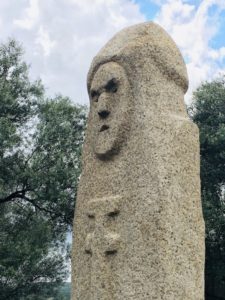
Standing stone. Photo: Debra Bokur
Over the years, we’ve visited a host of ancient stone sites — Stonehenge, dolmens in the countryside of Portugal and Ireland, henges and standing stones known as menhirs or liths in France, Wales and Spain — but Corsica seems somehow more romantically elusive. The island has, to date, around 500 discovered megalithic sites, and we’ve come to see two in particular.
Standing in front of a massive moss-covered dolmen at Filitosa, a village that’s arguably the island’s most important prehistoric site, it’s easy to let imagination run rampant over its construction, with images of a race of giant builders, or visitors from another galaxy arranging each stone carefully in place.
Whoever built them and for whatever reason, they have our full attention. The main dolmen’s gigantic flat cover stone providing a roof to what is believed to have been a tomb seems impossibly heavy for even a squadron of early residents to have fitted into place. We try, and fail, to work out how early people had the luxury or inclination to use up their valuable resources of time and energy to build such structures, when the imperative was surely simple survival and the gathering of food.
What sets Filitosa apart from other megalithic arrangements on the island, and ranks them as the Mediterranean’s most extant examples of Megalithic art, is the anthropomorphic element of the menhirs — many carved in the likeness of warriors and sometimes including images of swords or weapons.
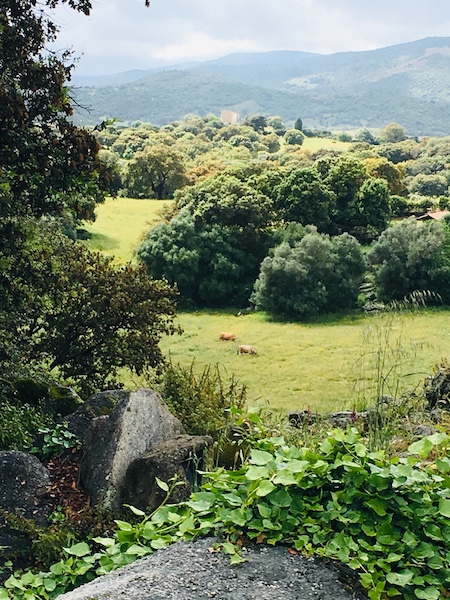
There’s a small, fascinating museum of artifacts at the entrance to the site, and a path leading to one of the carved figures. Holding a sword with the tip pointing toward the ground, the standing stone is adjacent to an older, broken stone dolmen. From here, the path winds through a lush, pastoral countryside that evokes the fictional landscape of J.R.R. Tolkien’s Middle Earth.
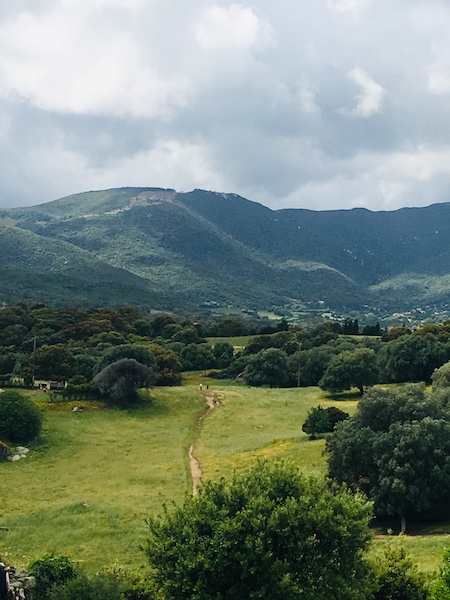
We reach another collection of dolmens and huts that once served as living quarters, then traverse a series of steep steps leading downward into the Taravo valley and directly to a monumental olive tree believed to be at least 2,000 years old. A wide circle of menhirs rises from the ground through the thick grasses around the tree, and a placard explains they were moved here by island settlers much later after their construction. Many of the original menhirs were overturned or broken by early invaders, who repurposed the stone to build their own structures. Before we head back up the path, we walk by the quarry where the stones originated.
During various periods of invasion, many of these ancient sites were destroyed by those opposed to their possible religious significance. Besides Filitosa, Corsica’s other major remaining sites are located on the Cauria plateau. At Palaghju, in the southwestern region close to Tizzani, lies the biggest collection of megalithic stones and menhirs found anywhere in the Mediterranean.
While most lack the carved aspects of Filitosa’s stones, the sheer number (258 megaliths and 70 menhirs) makes this spot a must-see during a visit to Corsica. Arranged in rows that tend to run from north to south, their purpose remains a mystery. As we drive away, we’re again overcome with wonder that anyone trying to survive 4,000 years ago had the spare time to invest in such a project. Unless, perhaps, they had some help. After our visit, we speculate about what, exactly, an intergalactic building crane might have looked like.
Read This Next
Celebrate the Holidays on Italy’s Lake Garda
Europe
Oct 5, 2026#WhereverFamily
Insta FeedDestinations / Mexico
Oct 7, 2026Introduce the Family to Día de los Muertos at Sandos Caracol
If you didn’t grow up celebrating holidays like Dia de los Muertos (Day of the Dead), you are probably more than a bit curious. But heading to a different country to experience a cultural event you aren’t familiar with can be a bit intimidating. Where’s the best place to go? How do you know what to do? Or not to do, for that matter? If Dia de los Muertos falls into that category for you, you might want to consider Sandos Caracol Eco Resort in Mexico’s Playa del Carmen. This resort lets you experience an authentic celebration firsthand without having to worry about all the details.
Sponsored Content
GET TO KNOW TAP FORBIZ
Unlock flexible, refined business travel with TAP Air Portugal’s program, TAP FORBIZ. Developed for small, medium and large Companies, with options for corporate events, TAP FORBIZ offers exclusive advantages adapted to each type of business.
Multigenerational
Oct 6, 20263 Multigenerational Family Vacation Spots You Won’t Want to Overlook
Traveling as a large family or group does not need to be any more complex than it already is. We picked out three top destinations perfect for multigenerational travel:
Cruises
Oct 6, 2026Holland America Line Unveils New Beach Club, Food Pavilion at RelaxAway, Half Moon Cay
Holland America Line recently revealed a refreshed RelaxAway, Half Moon Cay, the cruise line’s private island in the Bahamas. Now, guests sailing on the line’s Caribbean cruises will discover a new RelaxAway, where recently completed enhancements bring more ways for families to relax, dine and play.
Sponsored Content
Celebrating 25 Years of The Peninsula Chicago
June marked The Peninsula Chicago’s 25th anniversary, commemorating a quarter century for the hotel as a pillar of luxury on North Michigan Avenue.
Destinations / North America
Oct 6, 2026Pumpkin Patches, Corn Mazes at New England Farms
Along with the dazzling fall foliage painting New England in the fall, October brings harvest season, when farms from Maine to Rhode Island welcome families to pick pumpkins, go for hayrides and get lost in corn mazes … and maybe stop at a pumpkin festival on the way. Here are some favorite farms to look for:
ShareThis